

Achieving 99.9% Uptime During Mission-Critical Infrastructure Modernization
Federal agencies face a critical dilemma: legacy infrastructure is failing, but mission-critical operations can't tolerate downtime. Many IT leaders believe they must choose between modernization and reliability. The truth? With the right approach, you can have both.
The Mission-Critical Modernization Challenge
Federal agencies operating mission-critical infrastructure face unique constraints: aging systems approaching end-of-life, strict compliance requirements (FedRAMP, FISMA), 24/7 operational demands, and fixed budgets. Traditional "rip and replace" approaches create unacceptable risk. The question isn't whether to modernize—it's how to do it without disrupting essential services.
The Three-Phase Framework for Zero-Downtime Migration
Based on successful federal infrastructure transformations, we recommend a methodical three-phase approach:
Phase 1 - Comprehensive Assessment: Start with a complete infrastructure audit identifying all dependencies and integration points. Establish performance baselines to measure success. Most importantly, conduct detailed risk assessments and develop rollback procedures for every phase before making any changes.
Phase 2 - Parallel Build and Testing: Build new cloud-native infrastructure alongside existing systems—never as a replacement until thoroughly validated. Implement Zero Trust architecture from day one using proven solutions from innovative vendors. Conduct exhaustive load testing, security validation, and disaster recovery testing before any production migration.
Phase 3 - Seamless Migration: Migrate workload-by-workload with validation after each step. Deploy 24/7 monitoring during transition periods. Implement real-time performance tracking and automated failback capabilities so you can instantly rollback if anomalies are detected. This methodical approach takes longer but virtually eliminates downtime risk.
What Success Looks Like
When executed properly, agencies can expect:
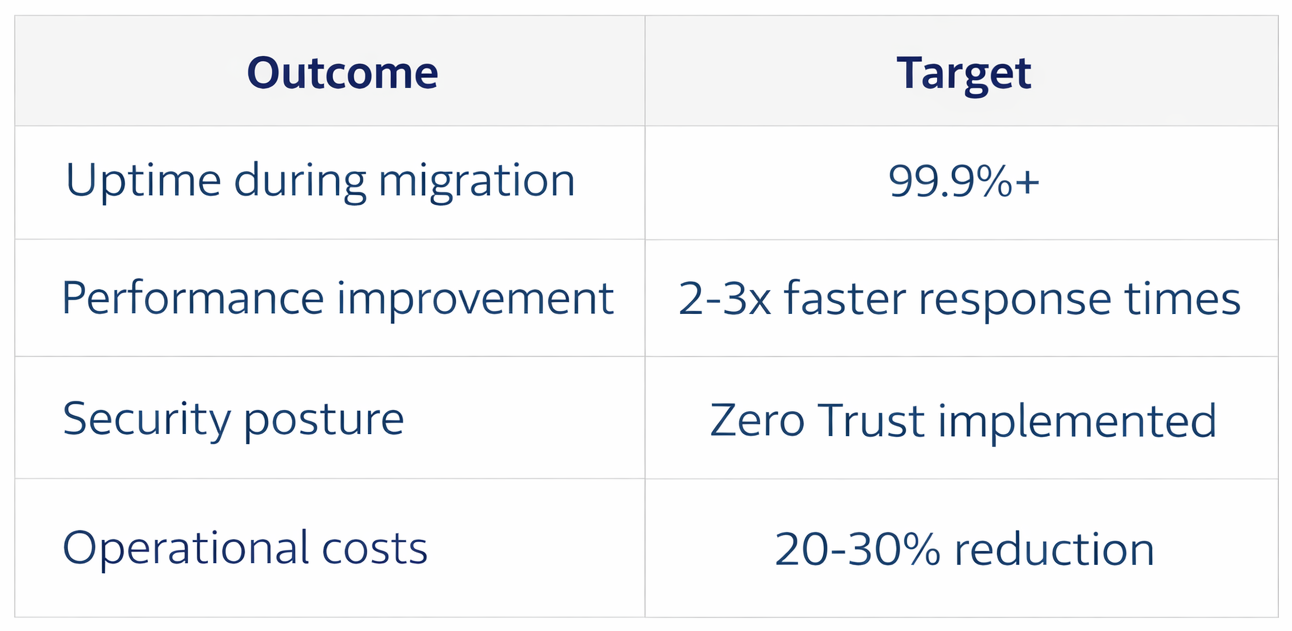
Beyond these metrics, agencies gain enhanced disaster recovery capabilities, improved scalability for future growth, reduced incident rates, and a foundation for continued innovation.
Critical Success Factors
Federal IT expertise: Partner with teams that understand federal compliance, security standards, and procurement processes. Generic IT modernization experience isn't enough—federal environments have unique requirements.
Proven technology partnerships: Work with vendors (*cough, CIG, cough*) who have established relationships with leading solution providers like Palo Alto Networks, Fortinet and Zscaler. These partnerships provide access to enterprise-grade tools and direct support channels.
Risk-first planning: Every decision should be evaluated through the lens of operational continuity. Plan for failure scenarios even if you don't expect them—thorough preparation is what prevents disasters.
Comprehensive testing: Test everything twice. Validate your validations. Never cut corners on quality assurance, even when schedules are tight. The cost of testing is always lower than the cost of downtime.
The Bottom Line
Mission-critical infrastructure modernization doesn't require accepting downtime as inevitable. With methodical planning, parallel infrastructure builds, and phased migration approaches, federal agencies can achieve both transformation and reliability.
The key is partnering with teams who understand that your mission can't wait—but it also can't be interrupted. At CIG, we specialize in zero-downtime migrations for federal agencies that need to modernize without compromise.
Ready to explore how your agency can modernize without downtime?